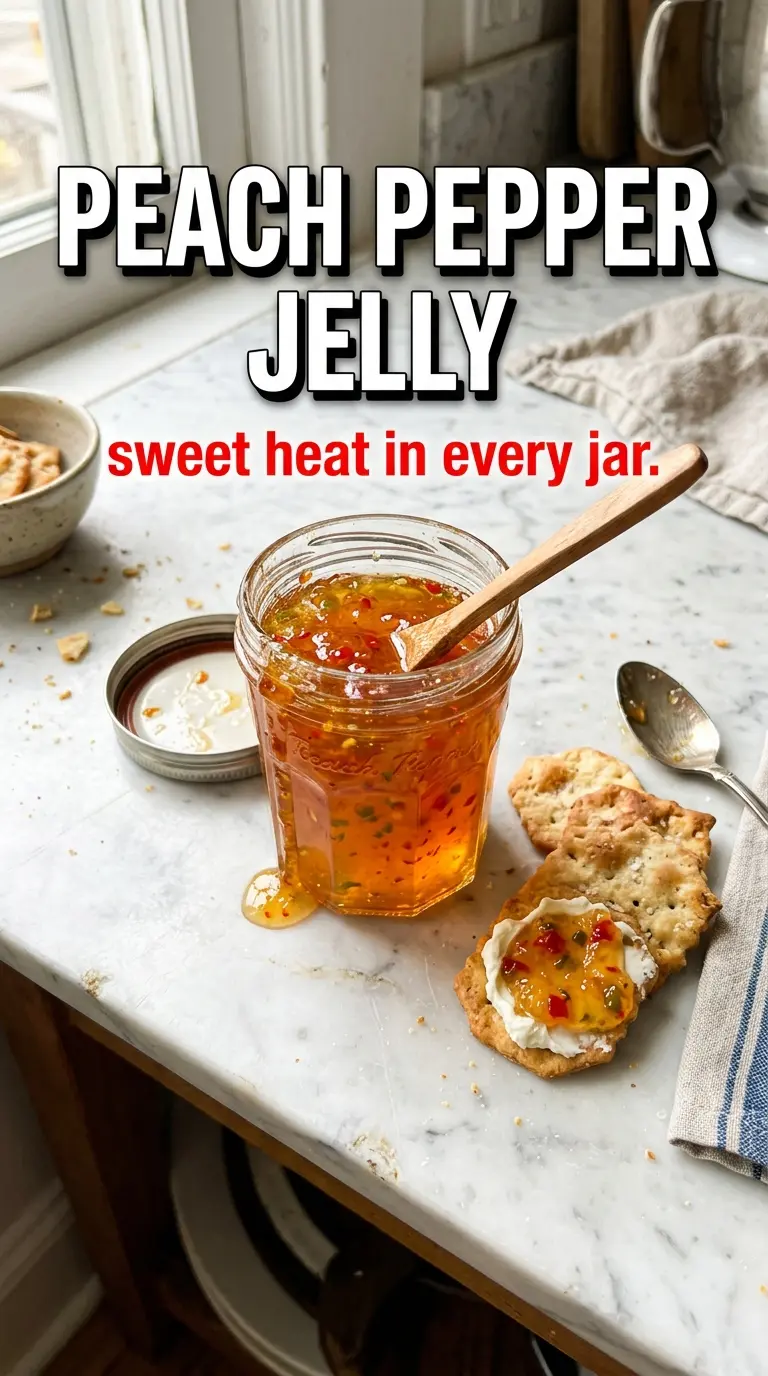
Peach pepper jelly sets up with a bright, glossy finish and just enough heat to keep each bite interesting. The peach stays front and center, but the red pepper and jalapeño turn it from a simple sweet jelly into something that actually belongs on a cheese board, brushed over roasted meat, or spooned onto a cracker with cream cheese.
What makes this version work is the balance between fruit, acid, sugar, and pectin. Peach puree gives it body and flavor, while the vinegar and lemon juice sharpen the sweetness so the jelly doesn’t taste flat. The peppers are minced very fine, which keeps them suspended in the jar and gives you those little flecks that make the finished jelly look jewel-like instead of cloudy.
Below, I’ll walk through the one-minute boil that matters most, the ingredient swaps that still keep the set reliable, and the storage details you’ll want if you’re making these jars ahead for gifting or snacking.
The jelly set beautifully and the little pepper flecks stayed suspended instead of sinking. I put it out with cream cheese and crackers, and the jar was gone before dinner.
Save this peach pepper jelly for the next cheese board, biscuit basket, or gift jar batch.
The part that decides whether peach pepper jelly sets or stays syrupy
The boil is the whole recipe here. Once the sugar goes in, the mixture needs to return to a full rolling boil that doesn’t calm down when you stir it. If the boil is too soft, the pectin won’t activate the way it should and the jelly will land loose instead of spoonable.
Peach puree brings more moisture than many other jelly bases, which is why the one-minute hard boil matters. That short boil gives the pectin enough heat to work without cooking the peach flavor into the background. The other common mistake is under-mincing the peppers. Bigger pieces can float unevenly or interfere with the set, and they also make the texture feel chopped instead of smooth and glossy.
- Peach puree — Use ripe peaches with good flavor, because the finished jelly won’t hide bland fruit. Peel them first; the skins can make the puree fibrous and muddy the texture.
- Red bell pepper — This adds color, sweetness, and the tiny suspended flecks that make the jars look polished. You can swap in another sweet red pepper, but don’t use large chunks or the jelly will look uneven.
- Jalapeño — Seeded jalapeño gives warm heat without overpowering the peaches. If you want a milder jelly, reduce the amount slightly rather than removing it completely, since the pepper is part of the balance.
- Powdered pectin — This is what gives the jelly its set, and there isn’t a substitute that behaves the same way in a quick-boil recipe. Use the package size listed; different brands and styles can change the gel.
- Apple cider vinegar and lemon juice — Both sharpen the sweetness and help the set stay stable. Bottled lemon juice is the safer choice for consistent acidity if you’re canning the jars.
What Each Ingredient Is Actually Doing in This Peach Preserve
- Fresh peaches (the fruit foundation) — Use ripe, flavorful peaches. Quality fruit makes quality preserves.
- Sugar (the preservative and sweetener) — Sugar prevents fermentation and creates the gel. Don’t reduce too much or preserves won’t set.
- Lemon juice (the acid and setting agent) — This lowers pH to prevent spoilage and helps pectin set the gel. It’s essential.
- Pectin (the gelling agent) — This creates the jam-like texture. Too much and it’s stiff; too little and it’s runny.
- Spices (cinnamon, cardamom, or vanilla) — These complement peach without overpowering it. Add sparingly for balance.
- Proper cooking temperature (220°F for jam) — This is crucial for the gel to set properly. Use a candy thermometer for accuracy.
- Bottling technique (hot jars and lids) — This creates a proper seal so preserves last. Follow canning guidelines for safety.
- Resting time (12-24 hours before opening) — This allows the gel to fully set. Patience here ensures the best texture.
How to move fast without missing the set
Build the base before the heat gets high
Combine the peach puree, minced peppers, vinegar, lemon juice, and pectin in a large saucepan before you turn the heat up. Stir until the pectin is fully dispersed and the mixture looks uniform. If you dump pectin into hot liquid or let it clump, you’ll end up with little gelled bits instead of a smooth jelly.
Boil hard, then add all the sugar at once
Bring the mixture to a full rolling boil over high heat, stirring constantly. Once it reaches that point, add the sugar all at once and get it back to a boil that cannot be stirred down. A weak boil here is the main reason jelly doesn’t set cleanly, so don’t wander off or lower the heat to control splatter.
Time the final minute exactly
Boil for exactly one minute after the sugar goes in, then pull it off the heat. Keep stirring the whole time so the bottom doesn’t scorch and the sugar doesn’t settle. If you cook it much longer, the jelly can turn overly firm or lose some of its fresh peach taste.
Jar while the mixture is still hot
Skim off any foam, then ladle the jelly into sterilized half-pint jars with 1/4-inch headspace. Wipe the rims, seal the jars, and process them in a water bath for 10 minutes. The jelly won’t fully set right away, so leave the jars undisturbed for 24 hours; moving them early can break the gel as it starts to form.
What to change when you want a different kind of heat
Milder peach pepper jelly
Cut the jalapeño back by half and keep the seeds out. You still get the pepper flavor and those pretty flecks, but the heat sits in the background instead of building on the finish.
Dairy-free and naturally gluten-free serving ideas
The jelly itself is naturally dairy-free and gluten-free as written. The most common serving is with cream cheese and crackers, so use your favorite dairy-free cream cheese or serve it with toasted bread, biscuits, or roasted chicken instead.
Extra spicy version
Leave some of the jalapeño seeds in or add a second pepper with more heat. That gives the jelly a stronger finish, but it also makes the pepper flavor more noticeable, so the peach should be very ripe or the balance will tilt too far toward heat.
How to use frozen peaches
Thaw the peaches first, then puree and measure them. Frozen fruit often releases extra liquid, so you want the measured puree, not the original weight, to stay close to the recipe’s ratio and keep the set predictable.
Storage and Reheating
- Refrigerator: Store opened jars in the refrigerator for up to 3 weeks. The jelly may firm up a little more after chilling.
- Freezer: This isn’t a good freezer recipe once it’s been canned, since freezing can change the gel and crack the jars. If you want to freeze a batch, leave it uncanned in freezer-safe containers and expect a softer set after thawing.
- Reheating: For serving, warm only the portion you’re using. A brief rest at room temperature loosens it enough for spreading; microwaving the whole jar can make the texture uneven and watery around the edges.
Questions I Get Asked About This Recipe

Peach Pepper Jelly
Ingredients
Equipment
Method
- In a large saucepan, combine peach puree, minced red bell pepper, jalapeño, apple cider vinegar, lemon juice, and powdered pectin, stirring well to evenly distribute the pectin.
- Bring the mixture to a full rolling boil over high heat, stirring constantly until the boil doesn’t calm when stirred.
- Add the granulated sugar all at once and return to a full rolling boil over high heat that cannot be stirred down.
- Boil for exactly 1 minute, stirring constantly, then remove the saucepan from heat to stop further cooking.
- Skim any foam from the surface with a spoon to keep the jelly glossy and clear.
- Ladle the hot jelly into sterilized half-pint jars, leaving 1/4-inch headspace.
- Process the jars in a water bath for 10 minutes, keeping the water at a steady boil for safe canning.
- Let jars rest undisturbed for 24 hours at room temperature until fully set and firm.